
It's the last Sunday of the month. Your ten-year-old opens Famnly before breakfast, taps the allowance card, and sees a number: 84%. Full payout. No Saturday-night scramble to catch up, no bargaining at the kitchen table, no last-minute trash run staged for the audience of one parent who happens to be looking.
The reason it worked isn't that the app finally shamed them into compliance. It's that the app had been quietly counting every Tuesday. Every morning bed-made. Every Thursday dish-dry. The month wasn't a test at the end. The month was the thing.
Why allowance and chores keep misfiring
Most allowance setups land in one of two modes. Either allowance is a flat monthly amount that arrives regardless of what happened — which the kid experiences as income, not outcome — or it's a per-chore bounty, a few kronor each, which turns every dish into a negotiation and every Sunday into a ledger. Neither mode teaches the thing the allowance is actually for.
The lesson you want a ten-year-old to learn isn't "labor has a price" — they'll get that later, in far more complicated ways. The lesson at this age is more boring and more useful: most of what earns money is showing up. Not heroics. Not the perfect week. Just the repeated, unglamorous, Tuesday-morning version of doing the thing you said you'd do.
The lesson isn't "work earns money". It's "most days earns money".
How the 80% rule works
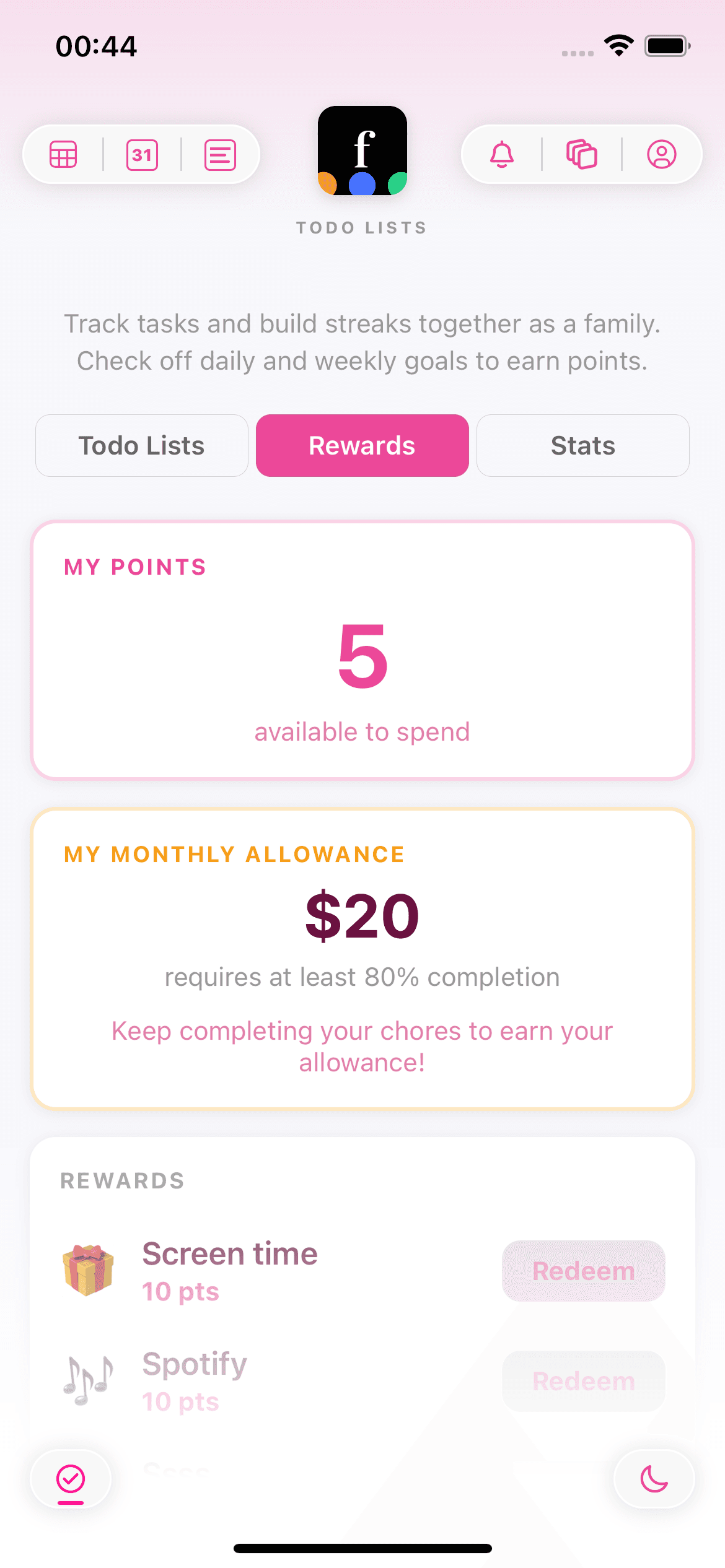
When you set up allowance in Famnly, you pick three things per child: an amount, a currency, and a minimum completion rate. The default is 80%. That means: if the kid completes at least 80% of this month's allowance-tagged chores, they get the full amount. Below that, the payout is proportional to what they actually did.
A child whose target is 500 kr at 80% who completes 84% gets 500 kr. A child who completes 60% gets 375 kr. A child who completes 20% gets 100 kr. Nothing is zero unless nothing happened. The curve is gentle on purpose — the point is not to punish a bad week, it's to make a good month feel visibly different from a poor one.
The separation you want: allowance and points are different things
Famnly runs two reward systems in parallel, and keeping them separate is the whole design. Every chore you create is either an allowance chore or a points chore. Not both. A chore that counts for allowance doesn't pay out reward points; a chore that earns points doesn't move the allowance percentage.
The reason is that these two things teach different lessons and shouldn't cross-contaminate. Allowance chores are the baseline — the bed, the dishwasher, the dog. Those are the things a family member does because they live in the family. Points chores are extras — the garage you didn't have to help with, the baby brother you watched while a parent cooked. Those are the things the household notices, and a kid can turn into ice cream or screen time at the Rewards marketplace.
How to decide which chore goes where
- Daily routines (making a bed, feeding a pet, unloading the dishwasher) — allowance. These are the ones you want consistency on, which is what the 80% rule measures.
- Weekly maintenance (bathroom wipe-down, taking out recycling) — allowance. Same principle: the month is the unit, not the task.
- Bigger or ad-hoc tasks (washing the car, raking leaves, helping a sibling with homework) — points. These are where the kid gets to opt in and feel the earn.
- Anything you'd feel weird paying per-completion for (being kind, doing well on a test) — don't put it in chores at all.
Setting it up in about ten minutes
- 1Open the Rewards tab and add an allowance rule for each kid: amount, currency, minimum completion (80% is the default — leave it unless you have a reason to change it).
- 2Go through the chores you already have and mark the ones that should count for allowance. A good first cut is three to five recurring chores per kid. More than that and the percentage stops feeling like a reachable bar.
- 3Tell the kid what the deal is, in one sentence: "If you do most of your chores most days, you get the full amount. If you miss a lot, you get less." Show them the allowance card. They'll check it themselves from then on.
- 4At the end of the first month, open the payout. You either pay the amount Famnly shows or you don't — the number is already calculated. Mark it paid. That's the loop.
What the 80% rule is and isn't teaching
This isn't a budgeting lesson. A ten-year-old with 500 kr isn't going to build a savings habit from a pie chart. It isn't a lesson in the labor market either — real jobs don't pay proportionally for 60% attendance.
What it teaches is narrower and, at this age, more important. It teaches what consistency feels like when it's paid out. The kid who makes their bed on a Tuesday they didn't want to, and then again on a Wednesday, and then notices on the 28th that the allowance card ticked from 78% to 81% — that kid has learned something nothing else in their life is set up to teach them. Which is that most of what works is just keeping going.
The Saturday-night scramble doesn't teach that. The flat monthly envelope doesn't teach that. A proportional payout, tied to a simple threshold, visible on the kid's own screen every day of the month — that's a shape that matches the lesson.