It's Saturday morning. Your nine-year-old is up before you, on her own phone, tapping through the chores view in Famnly. Nobody asked her. She's protecting an eleven-day streak and she wants the red bolt next to her name to stay red. You used to be the person standing at her bedroom door reminding her about the hamster cage. This morning, the streak is doing the reminding.
This is the thing about chores that most parenting advice gets slightly wrong. The problem isn't motivation. The problem is ownership. A chart on the fridge belongs to whoever drew it — which is you. A streak on a phone belongs to the kid whose face is above it.
Why the fridge chart fails
The fridge chart is a beautiful object on Sunday night and a dead object by Wednesday. You made it. You bought the stickers. You remember to look at it, and when you forget, nobody looks at it. The chart doesn't nudge anyone. It doesn't carry state. It doesn't celebrate. It's a static artifact of a parent's good intentions, and it lives or dies on whether that parent has the energy to enforce it this week.
Printable trackers, whiteboard columns, the apps that put three boxes next to each kid's name — they all share the same shape. The adult is the owner. The kid is the subject. Checking off a box is something that happens to the kid, not something the kid drives. That's why compliance drops the moment you stop paying active attention: the chart never belonged to them in the first place.
What works is the opposite arrangement. Give the child a dashboard that is their own. Show them a streak that is their own. Let the number move in real time when they do the thing. Then step back and see what happens when the system, not you, is the one keeping score.
Kids don't resist chores. They resist being managed. Give them a dashboard that's theirs and they'll manage themselves.
How ownership looks on a screen
In Famnly, a child with their own account lands in a view built for their age. They don't see family settings or the parent-facing editors. They see their tasks, their rewards, their streak, and — if they have siblings — a leaderboard. The rest of the app is gone. What's left is the kid's own progression.
Streaks that belong to the person, not the chart
Each family member has two streaks. A current streak — the red bolt next to their name — counts the consecutive days they've completed at least one chore. A longest streak — the amber bolt — holds their personal record. The kid can see both at once, which means the game isn't just "don't break today". It's "beat yourself".
That second bolt is the part that matters. A single streak is a scolding waiting to happen — break it and you're at zero. Two streaks means a broken day isn't a failure; it's just a gap before the next run at the record. The kid has something to chase even after they miss a Tuesday.
Points that float up when you complete something
Non-allowance chores earn reward points. Tap the checkbox, and the points don't just appear in a total somewhere — they float up off the task, a small number rising toward the points counter at the top of the screen. The phone buzzes with heavy haptic feedback. The whole motion takes half a second. It's the closest a chore will ever get to feeling like a video game, and it's the part kids mention first when you ask them what they like.
A leaderboard that only exists when it helps
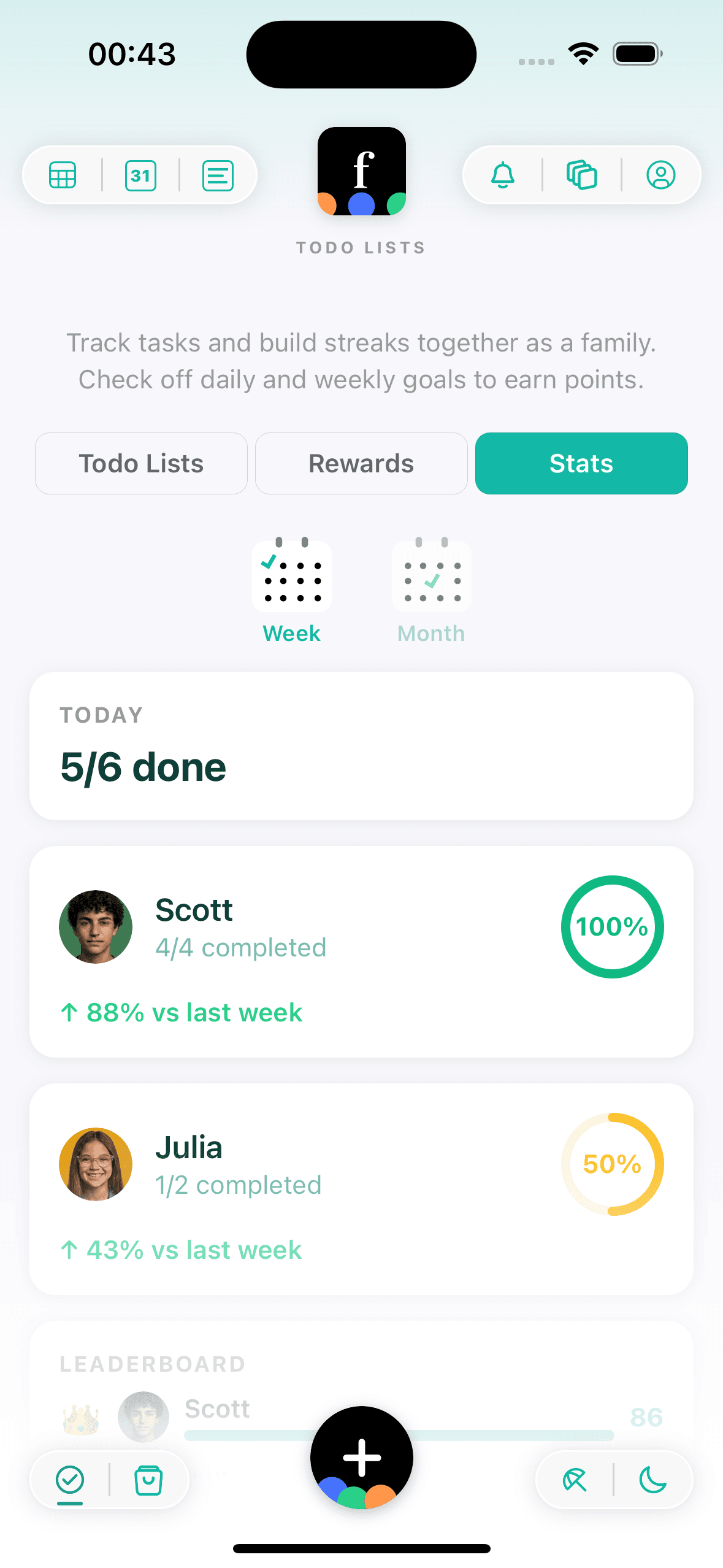
A single child doesn't see a leaderboard. There's nobody to rank against, and a leaderboard of one is just a grade. But with two or more kids, the stats tab shows a crown, a silver medal, a bronze medal, and the points each kid earned this month. Siblings notice the rankings immediately, and — in our testing — start competing without being told to. You didn't set up a competition. You just stopped hiding the score.
Setting it up so it actually sticks
The mechanics do most of the work, but the first week still matters. How you set the system up shapes whether the kid adopts it or treats it like another adult project. A short checklist we've seen work:
- 1Give each kid old enough to read their own account. A six-character code, entered on their phone, drops them into the child view. No email, no login, no settings they can break.
- 2Start with three or four chores, not ten. Pick ones the kid is already half-doing — feeding the dog, loading their plate, Saturday morning tidy. Early wins build the streak before the hard stuff is added.
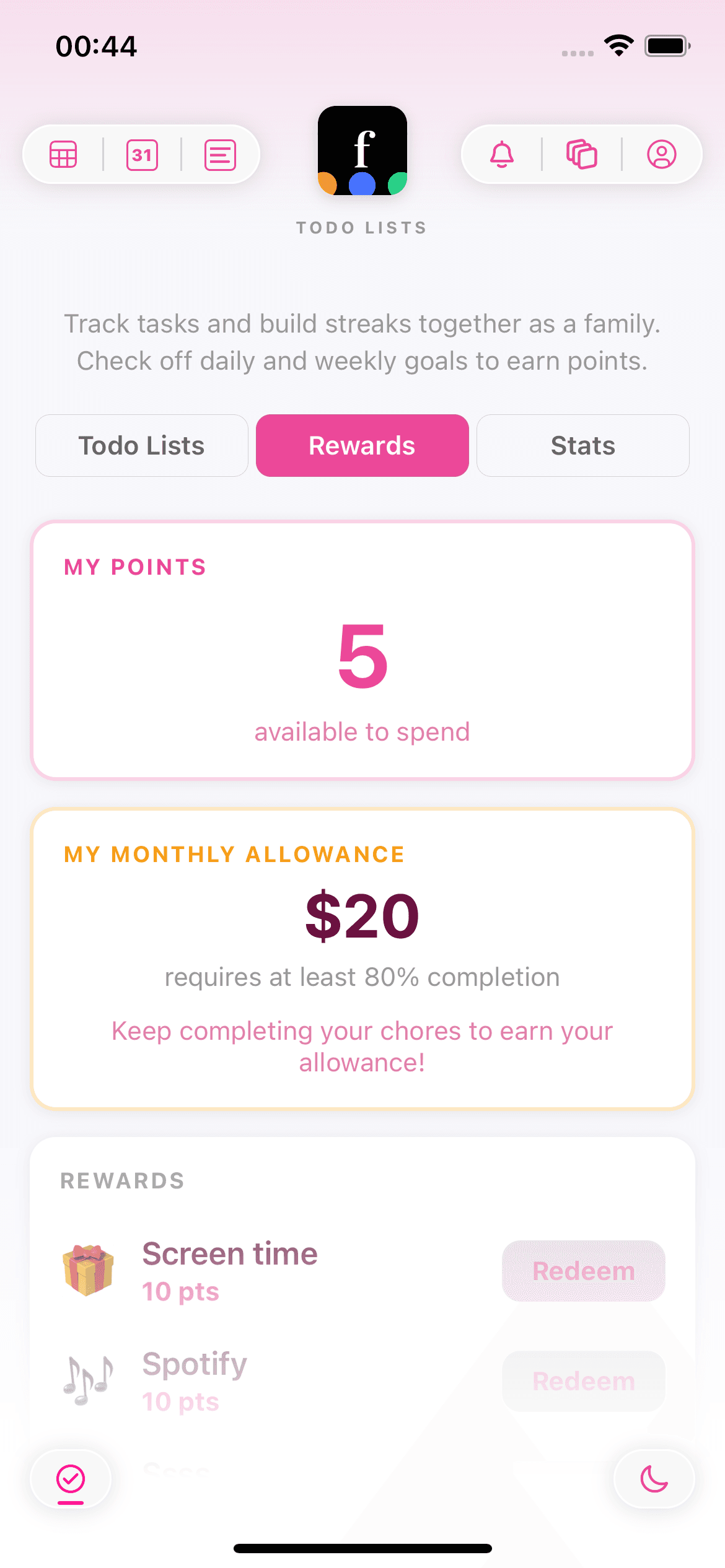
- 3Split the chores into two piles. A couple of high-frequency daily ones count for monthly allowance. The rest — one-off jobs, weekend extras — earn points the kid can spend in the rewards marketplace. Two loops, running at different speeds.
- 4Build the rewards list with the kid in the room. Ice cream trip, movie night pick, a later bedtime on Friday, a small toy. Let them suggest the point costs. They buy in faster when the prices were partly theirs.
- 5Use the nudge button sparingly. A tap from the parent view sends a single push to the assigned kid — fine for a real reminder, corrosive if you do it every hour. The streak is supposed to do the nagging. Let it.
- 6For the first two weeks, don't uncheck anything. If the kid marks something complete that wasn't really done, raise it in person, not in the app. The sanctity of the checkmark is what makes the streak feel real to them.
What it doesn't do
This doesn't make kids love chores. It doesn't turn a ten-year-old who hates putting laundry away into a ten-year-old who loves putting laundry away. What it does — and the ceiling is honest — is turn the daily power struggle into something that runs itself most weeks. The kid opens the app because the streak pulls them in. The points accumulate. The rewards tab is a real thing they can spend against. You stop being the reminder.
Streaks break. A sick day, a sleepover, a weekend where nobody remembered — the red bolt resets and the kid has to start again. That's fine. The longest-streak bolt is still sitting there in amber, and the next run is a run at the record. A system that handles its own failure modes is a system that outlasts your enforcement energy, and that's the only kind of chore system that actually sticks.